Adapting Instruction to Every Client’s Needs
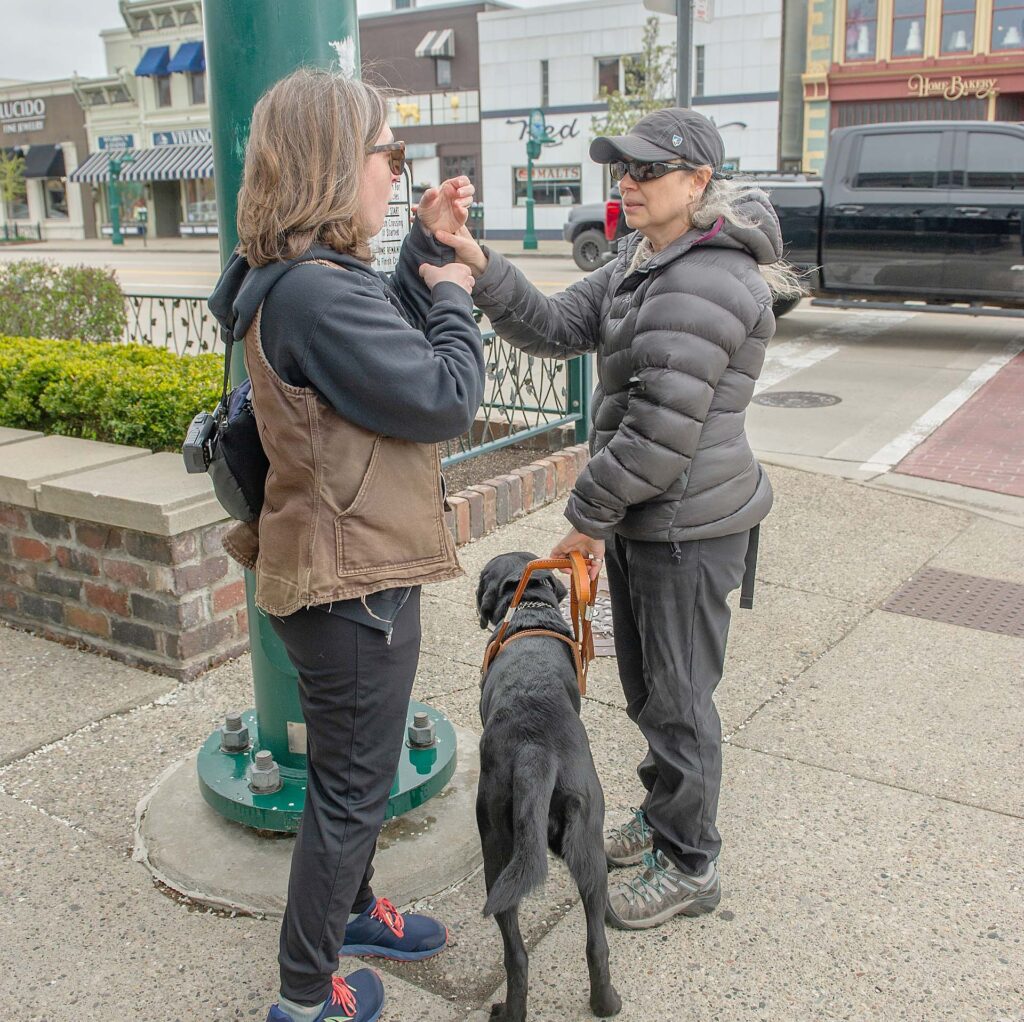
GDMI Sarah uses ASL to explain to Client Angela how to use a vibrotactile pedestrian signal at a street corner in downtown Rochester, Michigan. The client has a black Labrador in harness at her left side and signs with her right hand.
At Leader Dogs for the Blind, our top priority is ensuring each client receives customized instruction that allows them to develop exceptional skills to travel independently with a white cane or a guide dog. Though all our guide dog mobility instructors (GDMIs) and certified orientation & mobility specialists (COMS) are skilled at adapting the training process to accommodate a wide range of personalities and individual needs, the GDMIs on our adaptive services team also individualize client and dog instruction for additional client needs or disabilities that may be physical or intellectual.
Tailoring Training for Physical Disabilities
Leader Dogs for the Blind does not train dogs for balance or bracing, but for clients with an uneven gait, the GDMI will carefully select a dog that can maintain a straight line as the person’s gait wavers. “When training the dog,” said Kate Roberts, GDMI, adaptive services team supervisor, “we will practice techniques like stumbling and wavering while walking to prepare the dog for the client’s particular gait patterns.”
Another adaptation is training the dog to work on the client’s right side instead of the standard left side. This need may arise for a variety of reasons such as loss of a limb, multiple sclerosis or stroke. For individuals with arthritis, GDMIs may build up the harness handle with foam to make it more comfortable for the client to grip.
“We focus on every client as an individual, no matter their level of hearing loss, language usage, physical or cognitive limitations. We match the dog and the training to their specific needs because no one client is exactly like the next,” says Sarah Duyck, GDMI/COMS.
Instruction for people who are DeafBlind
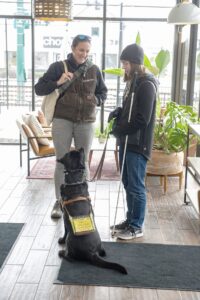
Photo description: GDMI Kate and Client Maya stand in a bright lobby full of windows reflecting on their morning instruction. Two chairs and a few plants are in the background.
People who are both deaf and blind can find navigating the world to be challenging. After working closely with DeafBlind clients, we began offering guide dog training in 1992 using American Sign Language (ASL) as the main method of communication. Today, Leader Dog is one of only two guide dog organizations in the United States to offer ASL as an instructional communication method.
In addition to the standard of matching a dog to a client based on the client’s pace, typical travel environment (e.g., big city, rural) and personality, when selecting a dog for a DeafBlind client, our GDMIs look for a dog who is easily engaged in learning. In addition, they look for a dog who enjoys physical contact such as petting or playing. Dogs with these traits are highly motivated to work with their handler, and are less distracted by their surrounding environment.
“We really prioritize dogs that are open to physical praise,” said Mara Renny, apprentice GDMI. “For our clients who do not use their voices, that physical connection becomes a primary method of communicating with and rewarding their guide dogs.”
During training, the dogs start learning how to work without vocal cues, instead responding to hand signals and physical cues like leg pats and other physical methods of maintaining the dog’s attention. Positive reinforcement through petting plays a key role, creating a powerful bond between dog and handler.
One graduate who has benefited immensely from this program is Maya, a young professional with Usher’s syndrome which causes dual sensory loss. Her Leader Dog, Paul, has given her the freedom to navigate the world with confidence and has become an invaluable companion.
“Paul has opened up activities like hiking that I thought were lost to me,” Maya shared. “Having that trust in him to keep me safe on the trails has been very emotional and freeing.”
Leader Dog Paul’s presence also provides Maya with a sense of security, putting her family’s minds at ease when she travels independently. From work conferences to vacations across the U.S., Maya and LD Paul maneuver through airports, public transit and bustling city streets.
Photo: A woman stands in front of two clients who are sitting in airplane chairs with their dogs at their feet at the downtown Rochester training facility. Caption: Mara Renny, LDB apprentice GDMI, uses ASL to explain to clients Maya and Enrique how to best situate their dog when traveling by plane.
“We really prioritize dogs that are open to physical praise. For our clients who do not use their voices, that physical connection becomes a primary method of communicating with and rewarding their guide dogs,” says Mara Renny, apprentice GDMI.
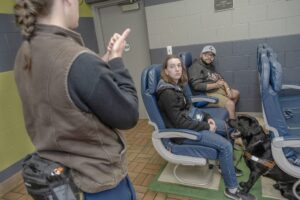
Photo description: Apprentice GDMI Mara stands in front of two clients who are sitting in airplane chairs with their dogs at their feet at the downtown Rochester training facility. Mara uses ASL to explain to clients Maya and Enrique how to best situate their dog when traveling by plane.
Addressing Intellectual Disabilities
For clients with intellectual disabilities, our adaptive services team provides small class sizes with more individualized attention. “We may have a lower instructor ratio and choose quieter training environments to reduce distractions,” explained Kate. “But we never sacrifice the quality of instruction – just adapt the delivery method.”
When identifying dogs that would make the ideal match for someone in this program, the GDMIs look for a mature dog that can handle task repetition, such as stopping at a curb for a longer period of time without frustration or boredom. Though it is a prime learning method for all clients and guide dogs, repetition can be increased when working with a person with an intellectual disability in order to successfully achieve travel goals.
The success of our clients who train with our adaptive services team is a testament to the power of inclusivity and our unwavering commitment, combined with the motivation and desire to succeed on our client’s part. With each guide dog partnership formed, another life is transformed, another barrier is overcome, and another step is taken towards a world of greater independence.
Photo: Two women use ASL at a street corner. The client has a black Labrador in harness at her left side and signs with her right hand. Caption: Sarah Duyck, GDMI, COMS, explains to client Angela how to use the vibrotactile pedestrian signals in downtown Rochester, Michigan.
The Leader Dog adaptive services team works hard to stay on top of advancements in the DeafBlind community. Most recently, they all completed a certification in Protactile Language Theory. Developed by DeafBlind people, Protactile language allows people who are DeafBlind to communicate with each other in group settings without the use of interpreters.
To learn more about Protactile, go to TactileCommunications.org or ProtactileLanguageInterpreting.org.
Fun Fact!
As far back as 1970 we were adapting equipment for clients like Bill W. who lost his forearms during the Vietnam War.
Ready to Learn, Support, or Make a Difference?
-
Apply to a Program
Learn the skills for safe, independent travel and lead a life without limits — all at no cost.
-
Donate
Since we receive zero government funding or insurance money, we rely 100% on the generosity of donors like you.
-
Volunteer
Every day, we rely on the support from our community of volunteers, made up of people just like you who make our mission possible.
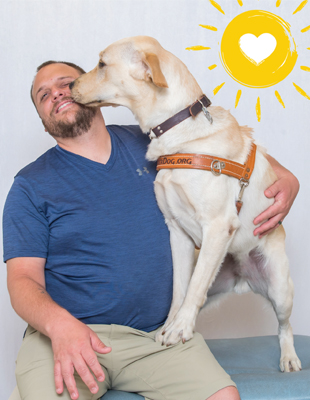
Change lives today by donating to the Summer of Hope Fund.
LAST CHANCE to take advantage of our Matching Gift Challenge
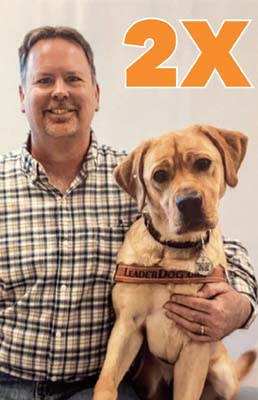
Support our $60,000 Matching Gift Challenge and have your gift DOUBLED!
Join Us For Dinner in the Dark!
Presented by AAA The Auto Club Group - March 20, 2026
Our signature fundraiser will take place at the Palazzo Grande in Shelby Township, MI. Every dollar raised supports life-changing programs at no cost to our clients, empowering people who are blind or low vision to live independent, confident lives.
The evening includes a family style dinner, an open bar, hors d'oeuvres, an ice cream and cannoli platter, an espresso station, and on-location parking.

A New Issue of the Faithful Friends Newsletter Is Out!
In our latest Faithful Friends newsletter, we highlight ways we are helping Leader Dog clients — and we invite you to learn how you can make a difference.