On the Road with Barry – Rochester Hills, Michigan
Day 0
I was supposed to be in Wisconsin this week, but my client fell and broke his wrist. He’s gonna be fine, but we’ll have to reschedule. I work people hard, but I’m not gonna make him work with a broken wrist. A last-minute cancellation made for some scrambling until the lovely ladies of client services found a local client who was willing to come in on (very) short notice. I quickly changed plans, got a flight, and waited for Sunday.
Checking in to my flight on Saturday, I noticed that the name for my departure terminal was remarkably similar to the main terminal in Detroit. It was remarkably similar because it was one and the same. In my haste, I approved a travel itinerary that had me traveling from Detroit to Houston instead of the other way around. Luckily, our travel agent has a live human being to talk to on the weekends, and I got things turned around. Lucky me, with my last-minute ticket, I got to sit in the very last row of the airplane, the seats that don’t recline. Only the flight attendants flew further back. An added bonus to being among the very last to deplane is that you get to witness everyone on the plane on their way to the restroom. I’m surprised, every time, at how many people use the airplane restroom. It is, literally, the smallest room on (or off) the planet, and I have no desire to be in there, much less perform necessaries. There’s not an airport on the planet that doesn’t have large, spacious restrooms scattered around, but once that seatbelt sign goes off, people start popping up like they were sitting on a spring headed back. I don’t get it.
Leader Dog is blessed with such a robust group of volunteers who perform a multitude of tasks alongside our staff, one of which is making runs to and from the airport to pick up clients. I had one scheduled to pick me up, too, before my big snafu. The clients, though, get a really soft landing by meeting someone in baggage claim who is looking for them, already has their luggage, and almost always has a sack lunch ready to hand out.
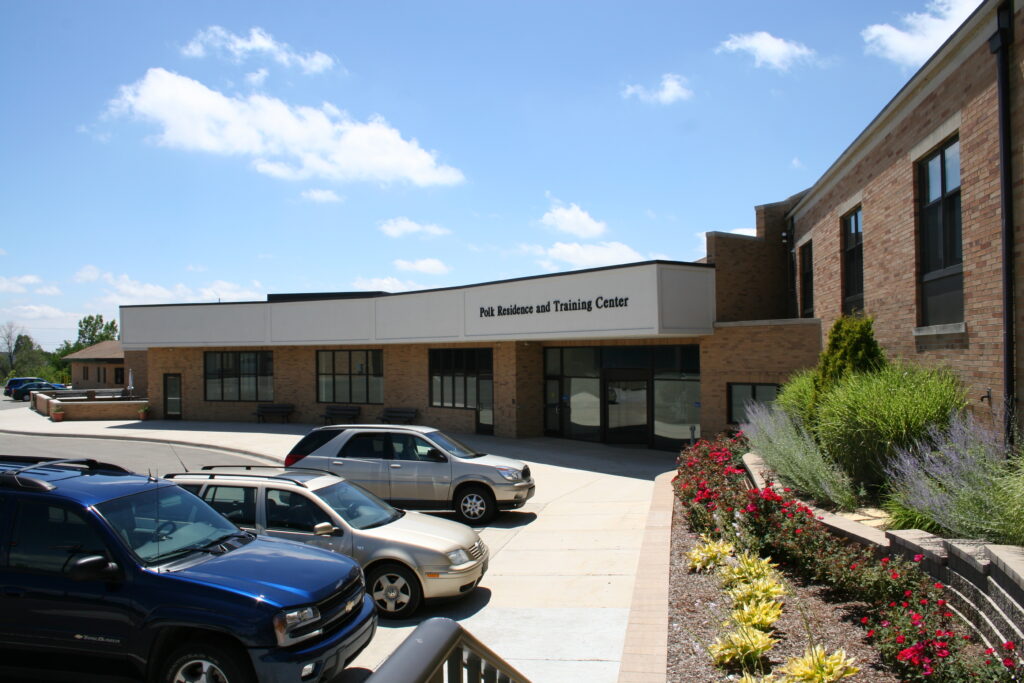
They’re driven to Leader’s campus where they are oriented to the building after settling into their rooms. You get your own room at Leader, with your own bathroom and thermostat, which is nice, but you eat meals in a common dining area. You also get fed like royalty during your entire trip. Three squares a day, by chefs, not cooks. People who really care about what they’re serving and how it gets served. The food is phenomenal, the Wi-Fi is strong, and the rooms are comfortable. We try, really hard, to make sure the only thing you need to focus on during your week of orientation and mobility (O&M) services on campus is your O&M instruction. I know I’m a little biased, but I think we do a really good job of it.
Day 1
We’ve got four clients this week. Sandy and Lisa are from Michigan, Keri is from Minnesota, and Christian is from Ohio. Four folks, four different eye conditions, four different levels of previous O&M instruction. All of them have a small degree of remaining vision. Not everyone is in the same boat, but they’re all in the same water: living life with impaired vision.
The dining table is a great place to get to know each other and share your common experiences. You’re not the only one out there dealing with this problem. Again, not dealing with it exactly like you are, but dealing with the same situations. The conversations around the table during the week are some of the most fulfilling for the clients.
Because I’m staying on campus, I get my own room and those wonderful meals as well. At the table I met Sandy, who will be my client for the week. Sandy has retinitis pigmentosa (RP), which slowly eats away at your peripheral vision. Often, your remaining central vision remains clear, so folks with RP will sometimes wait longer to seek services. Sandy is one of these and, while she has a cane, she does not use it much, and trusts it even less. We spend our morning getting to know each other a little better, learning how to walk with someone guiding you, and quickly jumping into cane skills.
Because Sandy has slowly lost her vision over a long period of time, she’s gone from holding her head up to looking almost straight down. And she’s in good company. Everyone with whom I’ve had the pleasure of instructing over the course of my career whose vision has decreased slowly has done the exact same thing. Honestly, you stop worrying about what’s ten feet in front of you. You just wanna know if your next step is clear or if you’re gonna drop off the edge of the world. It’s a natural reaction. My job is to help Sandy to trust her cane enough to find those obstacles and drop-offs under her feet so she can hold her head up.
I’ve preached on this topic before, but holding your head up makes such a difference in a few ways: it helps you keep your balance, it helps you walk a straighter line, it improves your posture, AND it allows you to use whatever remaining vision you have to help predict what’s gonna happen next. We were designed by our Creator to walk with our heads up. Even if you’re totally blind, I promise you, it will help you, too. But to do that, you’ve gotta have a mobility tool to help you find that stuff underfoot. A cane or a guide dog are travel tools that will help with that, and Sandy and I start our training walking up and down the long, straight halls at Leader doing just that, learning to swing it just a little wider than you are, trying to keep your cane in rhythm with your pace, and for pity’s sake, hold your head up!
Sandy and I get a lot of repetitions and work together on a reliable stair technique before lunch. After, we head to downtown Rochester to start getting around the block. Now, if you’re not aware, it’s cold in Michigan in the winter. There were already mounds of snow on the ground, and the arctic temperatures have made sure every bit of it still remains. Now, Sandy’s not too bothered by it, but this native Texan is. Luckily, Leader provides all of its program staff with great outdoor gear, and I’m wearing all of it today. I look like Sir Edmund Hilary whilst scaling Everest, but I’m “warm”.
Day 2
One of the great things, for me, about teaching at Leader is that I get to teach amongst friends and colleagues. Hannah and Jeanine are two of our on-campus O&M team, and Lynn is a contingent O&M instructor who is from Louisiana. Out on the road, I’m it. I’m the subject matter expert on all things, but here on campus, I’m part of a team that can help me out if I get into a jackpot. Tommy, Garett, Rod and Brad are also on our team, but don’t have clients this week. We spend our morning out in the tundra and come back to a semi-sad event. Tommy, previously mentioned, is leaving us. Tommy has one of the most unique points of view of anyone I’ve ever met, and for sure on our team. We’ll miss his humor, his camaraderie, his love of cheese, but mostly his way of thinking.
Sandy crossed her first street independently this morning, and we built on that success by making it a little harder. We started with quiet, stop-sign-controlled intersections, then moved on to those controlled by lights. Light-controlled intersections are all about pattern recognition. If you can find the pattern, you can figure out the best time to cross the street.
I got to go out to dinner with colleagues tonight. Again, something I don’t have the opportunity to do out on the road. I have noticed something, though, and maybe it’s just me getting old, but the restaurant was SO loud, I found myself trying to read lips, laughing when others laughed, and frowning when they frowned. I have not a clue as to what I might have agreed or disagreed to.
Day 3
Every Monday, Wednesday and Friday at Leader, without a hitch, I and every client who passes through our doors, goes to their room after breakfast to find their towels, washcloths, hand towels, and bathmats magically changed out with fresh ones. There are too many of them for me to name without leaving someone out, so I won’t try, but the folks that take care of the residence are as good as gold. Maybe better. They’re also very ninja-like. Unless you see or hear their cart in the hall, you’d never know they were there.
Three out of four clients went to Birmingham today, just for a different look at things. Birmingham is pronounced differently depending on where on the planet you’re from. If you’re from the south, like me, you put the emphasis on the “ham”. If you’re from Michigan, it all just flows out in one word, kinda. And if you’re from the UK, you don’t pronounce the “h” at all and change the last “a” to a “u”, coming out “Birmingum”. However, you pronounce it, Birmingum is a city not too far from Rochester in Michigan, where Garret says “Everyone has Starbucks in one hand and AirPods in their ears.” The training advantage to taking clients to Birmingham is that it’s different from downtown Rochester. So, this proves to the clients that the skills work despite the environment. This really helps when our clients get home because their environment won’t look exactly like the ones in which they’ve trained all week.
In the afternoon, two of the clients, including mine, went on an adventure down a busy road with heavier traffic, practicing determining intersection patterns and safely negotiating them. We had a bit of a close call with a right turner, which is not uncommon. Anyone crossing the street on foot, visually impaired or not, has to become comfortably numb to the presence of traffic. Know it’s there, that it’s gonna be close, and know that a lot of folks are not willing to wait for pedestrians. You just have to stay aware, and keep your head on a swivel like my old defensive line coach used to tell us.”If the fella in front of you doesn’t hit you, you better get your head on a swivel because somebody is!” It takes real guts to step out into the road with moving vehicles, even more so when you can’t see them, or see them clearly.
We ended the day learning to negotiate parking lots, which are evil, evil places. While intersections are harrowing, parking lots are like the wild west. Talk about keeping your head on a swivel…
Day 4
We went to the mall today. There’s a mall close to campus that contains escalators, elevators, and moving sidewalks. This mall is the one in which my client shops on a regular basis, but she’s very hesitant to use the escalators and moving sidewalk. I tell everyone that they’re no big deal, but when you can’t see them, or see them clearly, they ARE a big deal. Just like determining traffic patterns at intersections, there’s a specific technique used to negotiate escalators. The first step, just like stationary stairs, is the most important one. Because if you miss the first one, the rest of them don’t really matter, right? Simply, finding where the stationary part meets the moving part with your cane is the key. No escalator moves so fast that you don’t have time to adjust your feet forward or backward to be firmly on one step or the other. But having the courage to step out there the first couple of times is a big step — literally and figuratively.
Getting off is “easy” because when you feel yourself level off at the top or bottom, you can just lift your toes and let the floor slide under your feet, start swinging your cane and walk forward. The moving sidewalks are even “easier” because there’s no elevation. Just find where the stationary platform meets the moving piece and make your decisions from there. Sandy goes to church with the folks who installed the moving sidewalks at this mall, so I told her to brag to them on Sunday that she’d slayed another dragon on their installation.
This afternoon, we went to Meijer, which is a store like the big Walmarts, Targets and other similar places. Not only did we negotiate the evil, evil parking lot, we went inside and shopped. This is usually a big deal to clients dealing with vision loss, hopping on their own, or with limited assistance. You can always use the cart as your cane, if you have enough useable vision, or you can pull the cart from in-front while using your cane. Another thing that some folks don’t think about is asking for a shopping assistant at customer service. You can even call ahead and schedule a time. Now, every store does it differently, but if you call and ask your local grocery store, I betcha that they’d work with you.
Store familiarization is very similar to negotiating intersections that are controlled by lights. There’s a pattern to most of these big stores. If you think about any Meijer you’ve been in, or a super Walmart, etc., you know that there are two main entrances, customer service is at the front of the store in between these two doors, and the restrooms. There are usually aisles running straight to the back of the store from those two main entrances, with intersecting aisles that make up the different departments. They aren’t all designed exactly the same, but the main parts are usually that way. If you think about your home grocery store, I bet that you could tell me where I could find just about anything in that store, within an aisle or two. Shopping is like hand grenades and horseshoes: you just gotta get close.
Day 5
For O&M clients at Leader, Friday is a big day. Not only are you on the verge of completing five straight days of O&M training, but, if you’re interested, you can get a test drive with a Leader Dog, just to see what it’s like. Even if you’re not interested in using a guide dog as a travel tool, it can be fun just to see how it all works. About halfway through the week, we request dog walks from the guide dog mobility instructors (GDMI), and they pick out dogs that they’re training to walk a familiar route with our clients. Sandy is not interested in using a dog, but she wanted to do it, just so she knows what it’s like. The GDMI’s also use it to sort of test their dog on how it reacts to working with someone besides them because, eventually, that’s what they’re training them to do.
Lunch today is special because we have a celebration ceremony for our clients at the end of instruction. Now, the kitchen serves us world-class meals all week, but they always raise the bar. We had a wonderful meal, the clients were all celebrated, and they all headed to their rooms to pack up and get ready to go home. The locals usually go home on Friday afternoon, and both of ours do. The other two, along with Lynn and I, will fly out tomorrow. The last class of the year 2025 is in the books. New travels and adventures await. Merry Christmas, everyone. And a Happy New Year!
Written by Barry Staford, certified orientation and mobility specialist (COMS)
Ready to Learn, Support, or Make a Difference?
-
Apply to a Program
Learn the skills for safe, independent travel and lead a life without limits — all at no cost.
-
Donate
Since we receive zero government funding or insurance money, we rely 100% on the generosity of donors like you.
-
Volunteer
Every day, we rely on the support from our community of volunteers, made up of people just like you who make our mission possible.

A New Issue of the Faithful Friends Newsletter Is Out!
In our latest Faithful Friends newsletter, we highlight ways we are helping Leader Dog clients — and we invite you to learn how you can make a difference.